The Best Exposure Management Platforms of 2026
As we navigate through 2026, the cybersecurity landscape has never been more complex. With the relentless expansion of cloud environments, AI-driven infrastructure, and decentralized workforces, the traditional perimeter is completely gone. Because of this, Continuous Threat Exposure Management (CTEM) has shifted from a forward-looking theory to an absolute operational necessity.
Today, security teams aren’t just looking for tools that find vulnerabilities; they are looking for platforms that can proactively reduce risk and execute all five stages of the CTEM framework: Scoping, Discovery, Prioritization, Validation, and Mobilization. If you are looking to upgrade your exposure management stack this year, here is our definitive guide to the top platforms of 2026.
What Makes a Great Exposure Management Platform?
Important Features for Continuous Threat Exposure Management
Traditional approaches to exposure management often involve multiple, disparate tools, making it difficult to gain a cohesive view of your organization’s vulnerabilities. The best exposure management platforms on the market today are designed to unify vulnerability and exposure assessment data. They should provide your security team with a comprehensive picture of the organization’s attack surface, and help to prioritize remediation on the most severe threats or ones with outsized impact on the business. Exposure management platforms should also help to automate remediation orchestration workflows, which historically can be quite tedious, time-consuming, and repetitive.
In 2026, your exposure management platform should be capable of:
- Data Centralization: Exposure management platforms should seamlessly integrate with all sources of vulnerability and exposure assessment data to provide a comprehensive view of your attack surface. This includes data from vulnerability scanners, pentests, exposure assessment tools, adversarial exposure validation platforms, and Cyber Asset Attack Surface Management (CAASM) platforms.
- Continuous Discovery: Your platform should be able to continuously monitor assets and data sources to identify and deduplicate findings via a wide range of platform integrations.
- Contextual Risk Scoring: Exposure management platforms should enrich findings with contextual risk scores to help security teams make informed decisions about which vulnerabilities to address first. Risk scoring should not only incorporate vulnerability scoring systems like CVSS, but also factor in the potential business impact to determine the most pressing threats.
- Prioritized Remediation: After determining which threats are of highest impact to the business, CTEM platforms should help security teams automate remediation workflows, track resolution, and continuously validate remediation efforts via retest cycles.
- Enhanced Visibility: Exposure management platforms should provide a comprehensive view of your organization’s security posture, enabling you to measure and report on the progress of vulnerability remediation efforts over time.
- Improved Efficiency: Your platform should help automate the exposure assessment process and save valuable time and resources via features like streamlined reporting, automated findings delivery, and bi-directional syncing with ticketing and project management platforms.
- Flexibility and Scalability: Your platform should scale with your organization’s needs and provide an adaptable solution as your organization grows, data sources change, and the threat landscape shifts over time.
- Workflow Automation: Exposure management platforms should help to eliminate tedious, repetitive manual tasks, such as remediation orchestration workflows, to improve efficiency and reduce the risk of human error.
Supporting the CTEM Lifecycle
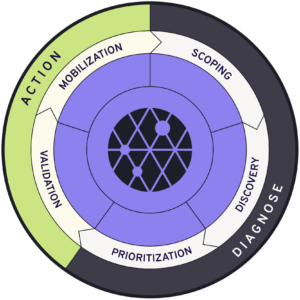
A great exposure management should also support every stage of the CTEM lifecycle. This five-stage framework helps to outline and enable a continuous risk-driven approach to proactively identify, prioritize, and remediate exposures. The five stages of the CTEM lifecycle include:
- Scoping: Define the assets, business priorities, and attack surfaces that matter most.
- Discovery: Identify and deduplicate findings from scanners, manual pentests, cloud tools, and validation platforms.
- Prioritization: Configurable risk scoring based on exploitability, threat intelligence, asset criticality, and business impact.
- Validation: Confirms exploitability and control effectiveness through retesting, attack path analysis, and purple teaming.
- Mobilization: Drives remediation to closure through ticketing systems, automated workflows, and risk reduction analysis.
The Top Exposure Management Tools in 2026
#1. PlexTrac: The Undisputed Champion of Mobilization and Workflow
When it comes to aggregating data, prioritizing risk, and actually getting things fixed, PlexTrac takes the top spot for 2026. While the market is flooded with platforms that excel at discovery, PlexTrac is the ultimate tool for mobilization. It bridges the notorious gap between offensive security teams (the finders), validation tools, and defensive teams (the fixers).
Key Strengths:
- Unified Exposure View across the Attack Surface: PlexTrac consolidates findings from penetration testing, vulnerability scanners, cloud security tools, and validation platforms into a single control center. The PlexTrac MCP server lets teams query that live exposure data to create dashboards and executive summaries in seconds.
- Contextualized Risk Prioritization: PlexTrac applies risk scoring equations built around your specific business context, taking factors like asset criticality, exploit availability, and finding severity to surface what actually matters in your environment.
- Purple Teaming Proving Ground: PlexTrac’s Runbooks module allows red and blue teams to collaborate seamlessly, tracking active exposure validation and proving defensive readiness in real-time.
- Executive Visibility into Risk Reduction: PlexTrac translates technical findings into business risk metrics and posture trends, giving executive-ready dashboards, portfolio views across teams or clients, and data to demonstrate measurable risk reduction over time.
- Mobilization that Closes the Loop: Native bi-directional Jira and ServiceNow integrations route findings to the right owner and sync status back to PlexTrac in real time, with built-in SLA monitoring so remediation stays on track from assignment to closure.
The Verdict: If your goal is to stop drowning in alerts and actually execute the final, most critical stage of CTEM—fixing the problems—PlexTrac is the most effective platform on the market today.
#2. Tenable One: The Vulnerability Veteran & Analyst Leader
Tenable has long been a heavyweight in the vulnerability space, and Tenable One continues to dominate in 2026, having recently been named a Leader in the Gartner Magic Quadrant for Exposure Assessment Platforms.
Key Strengths:
- Massive Vulnerability Database: Leverages its world-renowned Nessus technology for incredibly deep and accurate scanning across IT, OT, and IoT.
- Agentic AI: Tenable has heavily integrated AI-driven analytics into its 2026 platform to guide remediations, generate attack paths, and enhance risk prioritization.
- Lumin Risk Scoring: Provides a solid, mathematically backed cyber exposure score to help benchmark against industry peers.
The Verdict: While its detection and AI capabilities are world-class, its post-discovery workflow and reporting features aren’t quite as agile as PlexTrac’s when it comes to hands-on, multi-tool remediation tracking.
#3. Wiz: The Cloud Exposure Master
It is impossible to talk about exposure management in 2026 without talking about Wiz. For organizations heavily invested in AWS, Azure, and GCP, Wiz has become the gold standard for Cloud Exposure Management, focusing heavily on what attackers can actually exploit in the cloud and code layer.
Key Strengths:
- The Toxic Combination Engine: Wiz excels at connecting multiple signals (e.g., a misconfiguration + a vulnerability + exposed secrets) to identify real, imminent risk.
- Agentless Speed: Because it connects via cloud APIs, deployment is frictionless and provides visibility in minutes without impacting workload performance.
- Developer Context: Traces cloud exposures all the way back to the developer code repository.
The Verdict: Wiz is unparalleled in the cloud, but organizations with heavy on-premise infrastructure or complex legacy endpoints will need to pair it with a traditional IT exposure tool.
#4. XM Cyber: The Attack Path Pioneer
If your primary concern is understanding exactly how an attacker could pivot through your hybrid network, XM Cyber is a standout choice. This platform specializes in attack path management, showing you the exact routes an adversary would take to reach your crown jewels.
Key Strengths:
- Continuous Modeling: It constantly maps your environment to find hidden attack vectors that traditional scanners miss.
- Choke Point Identification: Highlights the specific intersections in your network where patching one vulnerability can disrupt dozens of potential attack paths.
The Verdict: XM Cyber is brilliant for visualization and pathing, but it usually needs to be paired with a broader workflow management tool to handle the administrative side of the remediation lifecycle.
#5. Brinqa: The Cyber Risk Graph Engine
For large enterprises struggling to make sense of disparate data streams from all the tools mentioned above, Brinqa is a powerhouse. Brinqa approaches exposure management by building a comprehensive “Cyber Risk Graph,” connecting security data with IT and business context.
Key Strengths:
- Massive Integration Ecosystem: Brinqa boasts hundreds of out-of-the-box connectors, seamlessly pulling in data from your scanners, CMDBs, and ticketing systems.
- Dynamic Risk Modeling: It links vulnerabilities directly to business services, meaning if a low-scoring CVE impacts a mission-critical revenue app, Brinqa flags it for immediate attention.
- Automated Ticketing Orchestration: It excels at routing specific remediation tasks to the exact right developer or IT owner via Jira or ServiceNow.
The Verdict: Because Brinqa is highly customizable and deeply integrated, deployment can be complex and resource-intensive. It is best suited for highly mature enterprise teams with dedicated engineering resources.
Summary: Choosing an Exposure Management Platform
Choosing the right exposure management platform depends entirely on your team’s maturity and specific architecture. In an era where security teams have more than enough tools for finding problems, the ultimate force multiplier is a CTEM solution like Plextrac’s that prioritizes workflow efficiency, team collaboration, and getting things fixed.