

Common Types of Penetration Tests
- The Many Different Types of Penetration Tests
- TL;DR on Types of Pentests
- Network Pentests
- Physical Pentests
- Software, API, and Application Penetration Testing
- Wireless Penetration Testing
- Social Engineering Pentests
- IOT/Mobile Penetration Testing
- Cloud Penetration Testing
- Container Penetration Testing
- PCI Penetration Testing
- Balancing Different Pentest Types
The Many Different Types of Penetration Tests
Every organization has a unique footprint, technology stack, and risk appetite, so when it comes to penetration testing, the methodologies used and focus of the simulation can be highly variable. The pentesting process and subsequent reporting should be tailored to the specific target and attack vectors that are simulated.
In this guide, we’re breaking down the most common types of penetration tests and the typical attack vectors for each type. For a refresher on the importance of penetration testing and the typical process, check out our introduction to penetration testing here.
TL;DR on Types of Pentests
All pentests generally fall into the following categories based on the target or attack vectors being simulated:
- Network Pentests
- Physical Pentests
- Software, API, and Application Penetration Testing
- Wireless Penetration Testing
- Social Engineering Pentests
- IoT/Mobile Penetration Testing
- Cloud Penetration Testing
- Container Penetration Testing
- PCI Penetration Testing
We’re breaking down each of these pentest types in more detail below.
Network Pentests
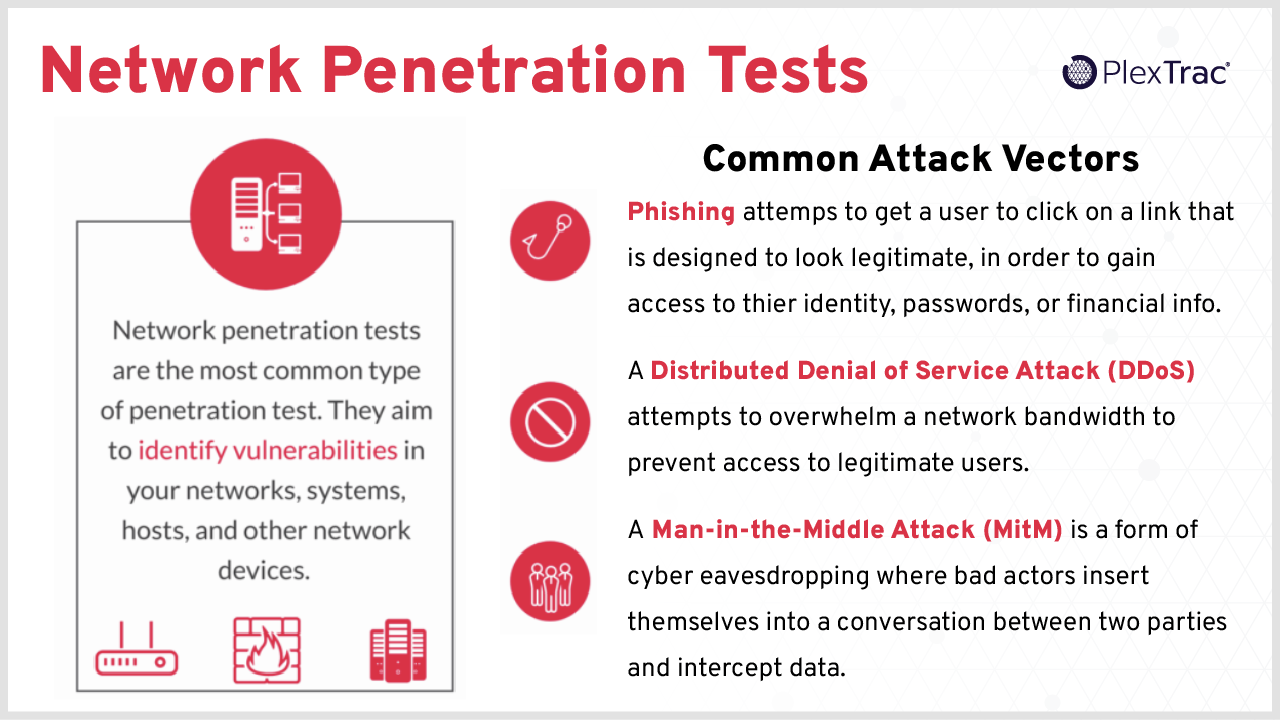
Network penetration testing focuses on internal and external penetration testing to determine the level of security on each network. Internal testing is run within the organization’s network, while external testing is done from an external network, simulating a real-world attack.
Network pentests are the most common pentest. It analyzes the security within firewalls, routers, servers, and switches.
Physical Pentests
Although it’s less often exploited these days, physical penetration tests assess physical security controls, like door locks, badge systems, ID checks for restricted access areas, and other potential entry points into a facility.
Physical pentests mimic malicious actors by attempting to breach security gateways through social engineering, lock-picking, and bypassing access controls and surveillance. If even one attack vector is successful, an attacker could take control of your business and its data. So even if physical breaches aren’t as common as Jurassic Park may make them seem, they are important to test.
Software, API, and Application Penetration Testing
Application pentesting and software penetration testing, as you may have guessed, target software, web applications, and application programming interfaces (APIs) to uncover issues, such as SQL injection or broken authentication.
Penetration testing in software testing is performed across web applications to identify vulnerabilities in the application’s code, such as cross-site scripting.
Wireless Penetration Testing
Wireless penetration testing, aka Wi-Fi penetration testing, simulates cyberattacks on wireless networks to find vulnerabilities in the network’s security protocols, encryption, or access controls.
Business wireless networks require testing to ensure cyberattackers won’t log into the business Wi-Fi and gain unauthorized access to data. In addition, pentesters will assess the network for security gaps, like lax encryption, device monitoring, wireless network structure, and weak passwords.
Social Engineering Pentests
Social engineering (SE) tests often include phishing, pretexting, or baiting attacks to evaluate employee susceptibility. SE assessments leverage real-world attack scenarios and TTPs (tactics, techniques, and procedures) to raise employee awareness and uncover less-than-ideal security policies and technical controls that should be able to detect SE attacks automatically.
According to a recent PurpleSec report, 98% of cyberattacks leverage social engineering, where threat actors deceive users into revealing security intel, such as logins or passwords. Pentesters often use TTPs such as phishing, vishing (voice-based scamming), and smishing (text-based scamming) to scrutinize and enhance employee training and safeguards.
IOT/Mobile Penetration Testing
IOT/Mobile penetration testing helps identify vulnerability exploits on mobile devices as well as all devices connected to that network, which could lead to vulnerable vectors for an attacker to exploit. This type of pentest pinpoints hardware or software security gaps in connected devices that are not covered within standard network penetration tests. These tests may also include any products your company sells, as well as mobile application penetration testing.
Common weaknesses in devices on your Internet of Things (IOT) network include unencrypted data, even at rest, or use of insecure protocols, like transferring unencrypted data.
As mentioned, IOT includes the interconnected network of physical devices, but it may also refer to smart devices within vehicles, buildings, and other items embedded with sensors. Ensuring they are safely controlled and monitored, even remotely, is important for your organization’s security.
Cloud Penetration Testing
Cloud penetration testing assesses cloud infrastructure configurations, such as identity and access management (IAM), and deploys applications to unveil issues around any cloud complexity misconfigurations, or abused API keys, microservices, or user accounts.
Container Penetration Testing
Container penetration testing examines and tests containers for container image security and the underlying host system. Although container security flaws may appear similar to those in applications, such as unauthorized systems or data access, the container image itself could introduce breakout vulnerabilities that may grant access to the host system. Container testing may also leverage image scanning, runtime security testing, and host and guest network pentesting.
PCI Penetration Testing
PCI penetration testing, also known as Payment Card Industry Data Security Standards (PCI DSS) testing, specifically focuses on evaluating an organization’s cardholder data environment (CDE) security and ensuring compliance with the PCI DSS requirements. Running proactive pentests on PCI systems helps prevent breaches and protects sensitive cardholder information, all while meeting the required compliance.
Balancing Different Pentest Types
No single penetration test is the right choice for every organization. Network, physical, web application, cloud, mobile, API, wireless, PCI, and social engineering pentests each uncover different types of security weaknesses, and together they provide a more complete view of your organization’s attack surface.
By selecting the right type of penetration test based on your environment, risk profile, and compliance requirements, you can identify exploitable vulnerabilities before attackers do, strengthen your security posture, and prioritize remediation efforts on issues with the greatest impact.